 Sideshift
 exchanges crypto with direct settlement to your wallet
Sideshift exchanges supported cryptocurrencies and sends the exchanged funds directly to your chosen wallet address. A swap, called a shift, links a deposit asset and network to a receiving asset and network. The browser service automatically creates an account without a sign-up form. Pricing and processing depend on the selected pair, rate mode, and deposit conditions.
The choices start with assets and networks, then extend to pricing and access. A successful shift needs compatible addresses and a completed payout transaction. Available pairs and deposit limits can change with operating conditions.
The deposit address and receiving wallet have separate jobs
A shift’s deposit destination belongs to the exchange; its receiving address specifies where the exchanged asset goes. Those addresses can involve different coins, different networks, or both, depending on the supported pair. Supported routes also allow a listed asset to move between available networks. The service automatically rebalances coin inventory to meet exchange demand and, for some coins, executes trades through decentralized finance pools. Execution varies by coin, while each order records its receiving asset, network, and address. The exchange controls deposited funds during processing.
Network compatibility and completed settlement
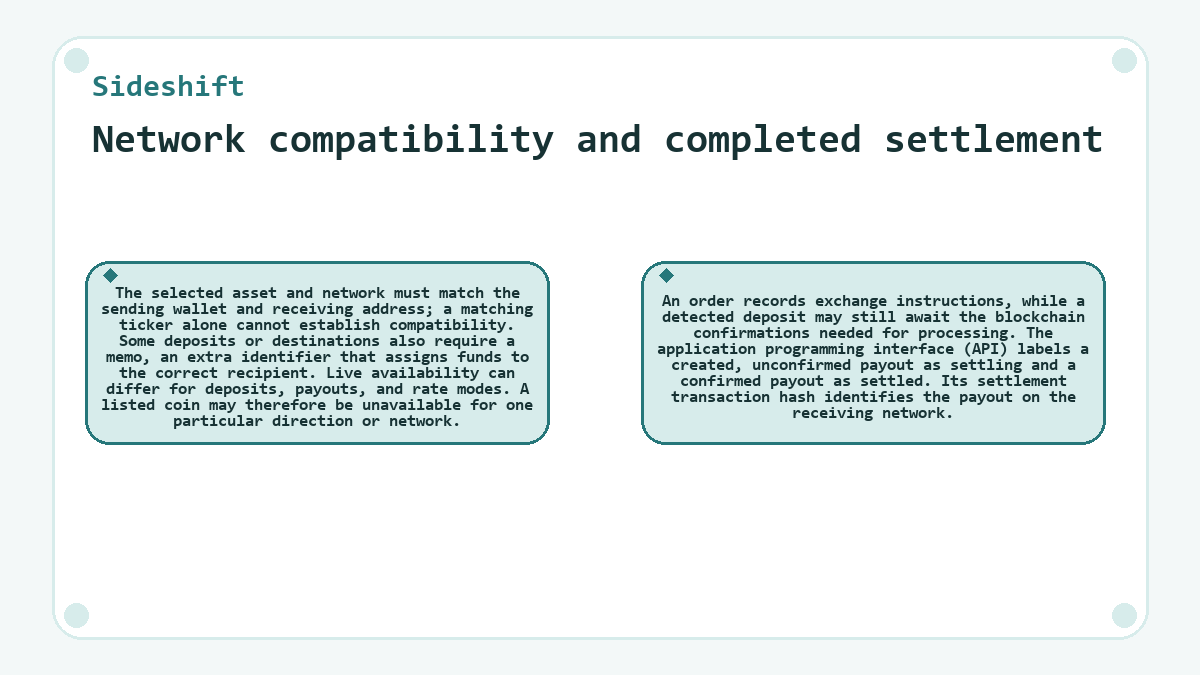
The selected asset and network must match the sending wallet and receiving address; a matching ticker alone cannot establish compatibility. Some deposits or destinations also require a memo, an extra identifier that assigns funds to the correct recipient. Live availability can differ for deposits, payouts, and rate modes. A listed coin may therefore be unavailable for one particular direction or network.
An order records exchange instructions, while a detected deposit may still await the blockchain confirmations needed for processing. The application programming interface (API) labels a created, unconfirmed payout as settling and a confirmed payout as settled. Its settlement transaction hash identifies the payout on the receiving network.
Does Sideshift require registration or verification?
The browser service creates an account without a registration form, and flagged transactions can require verification. Each account contains transaction history and has its own identifier and private key. That service credential is separate from a wallet’s signing keys.
The service’s private key grants full account access. Saving it securely protects access to transaction records and earned balances.
Eligibility rules exclude citizens, nationals, and residents of specified jurisdictions, including the United States. Users must meet the applicable legal-age requirement and be beneficial owners of the currency and the sending and destination addresses. These rules apply to transactions through integrations as well as browser swaps. Risk screening can flag deposits or settlement destinations for associations with illegal or malicious activity, pausing affected shifts for human review. Approved shifts proceed; rejected shifts can lead to account suspension and a refund after a holding period. Serious flags require verification before a refund, while verification can shorten other flagged refund waits.
The service can collect transaction details, IP addresses, device information, and usage data. Wallet addresses and transaction details can remain visible on public blockchains, and the operator may disclose information to meet legal obligations.
How do fixed and variable rates change a shift?
Fixed rates reserve a quote until its displayed expiry; variable rates lock when the service receives the deposit. A fixed order requires the exact deposit amount attached to that quote. A variable order accepts amounts within its specified deposit range, with pricing determined at receipt. The displayed expiry governs whether an order’s terms remain usable. Asset availability may also restrict which rate mode a network supports. The choice concerns amount precision and exposure to rate changes before receipt. Blockchain confirmation timing remains a separate dependency.
Network fees and pair limits shape the payout
Each pair’s receiving amount reflects exchange pricing and the network costs that apply to that route. Fixed-rate quotes incorporate network fees into the quoted rate; the browser’s variable-order page lists estimated network fees separately from the live exchange rate. The service may need to send a payout and, for applicable token deposits, sweep funds from a deposit address. Those operations contribute different network costs. The sending wallet may also charge a transaction fee, so its total debit can exceed the amount delivered to the exchange.
The deposit minimum changes with the pair and network fees. Sideshift sets the maximum, which can differ between assets. The order’s live range sets the boundary for normal automatic processing. Amounts outside that range can require human review and may settle or return as a refund.
Swap interfaces and rate options
Browser access, wallet connections, integrations, and chat change how a shift is prepared; the selected pair governs settlement. Connecting an Ethereum wallet can autofill its receiving address and allow deposits from that wallet where supported. Trezor Suite and Edge Wallet provide integrated access inside their applications. The Telegram bot supports guided text orders and AI-assisted requests. Voice input requires an opt-in to transcription and confirmation of the parsed order. Server-side API requests must carry the end user’s IP address, so permission checks apply to the trader accessing the exchange.
| Option | Main use | Required input | Operating condition |
|---|---|---|---|
| Browser interface | Prepare a direct wallet swap | Selected pair and receiving address | Selected assets and networks must be available |
| Connected Ethereum wallet | Autofill an address and send supported deposits | A compatible connected wallet | Sending funds requires wallet confirmation |
| Wallet integration | Shift inside a wallet application | Supported wallet assets and destinations | Wallet and exchange availability both apply |
| Telegram bot | Create and track orders in chat | Asset, network, and receiving-address details | Parsed AI orders require confirmation |
| REST API | Build a custom swap interface | Service account credentials and order fields | User permissions and per-IP request limits apply |
| Fixed-rate order | Reserve quoted exchange terms | Exact quoted deposit amount | Exact deposit must arrive before displayed expiry |
| Variable-rate order | Price a shift at deposit receipt | Deposit within the specified range | Rate remains changeable before receipt |
Review holds, refunds, and mistaken deposits
An unresolved shift can reflect an unconfirmed deposit, an amount problem, or a review hold. A review may end in settlement or a refund, depending on its cause. Support needs the order identifier and deposit transaction information to locate the exchange. These details belong in the support conversation.
A refund requires an address that accepts the original deposit asset on its network. A predefined destination lets eligible refunds proceed without another address request. Without a refund destination, the order can remain queued until the user supplies one. A queued refund and a confirmed refund transaction represent different states.
Wrong-token or wrong-network deposits require a separate recovery assessment. Recovery depends on access to the funds on the network actually used. Wrong-token deposits to a smart-contract deposit address can be assessed on the same chain; the recovery policy treats deposits to that address on another chain as lost. The service assesses requests individually, and it will not recover funds if network recovery fees exceed the deposit’s value.
An expired shift’s deposit address can later be reassigned, so it cannot serve as a standing address for future swaps.
XAI and referral earnings have different roles
XAI is the exchange’s ERC-20 token on Ethereum. Referrers earn from attributed users’ completed swaps, while integrators earn from completed swaps routed through their products. Referral commission applies only when a user’s first visit to the website is through the referral link. The commission that an integration selects affects the rate that its users receive. Configured payout settings can direct integration earnings to a supported asset and wallet.
XAI staking rewards ended on June 3, 2026. Already distributed rewards remain the holder’s property, and existing staked funds remain eligible for the established unstaking process. Historical staking yields describe the discontinued reward program. The account-based unstaking interface redeems svXAI for XAI.
Sideshift FAQ
-
Do I need XAI to exchange other supported coins?
- Exchanging other supported assets does not require holding XAI. The order specifies the deposit asset and receiving asset, and its pricing covers the applicable exchange costs. XAI has separate token and incentive functions; it is not a mandatory payment token for every shift.
-
What happens if my wallet subtracts its fee from a fixed-rate deposit?
- Fee subtraction can leave the delivered deposit below the amount that the fixed order requires. The relevant amount is what reaches the deposit address, not the wallet’s total debit. Some slight discrepancies may still settle; other mismatches require review or a refund.
-
Why can the deposit hash differ from the transaction ID in my wallet?
- On networks that use a sweep, the API’s deposit hash can identify the transfer from the shift’s deposit address to the exchange’s main address. The sending wallet records the original payment. These hashes describe different transactions within the deposit process, so their difference alone does not establish a missing payment.
-
Can I send another deposit to the same shift?
- Fixed-rate shifts settle only the first valid deposit and refund additional deposits. Variable shifts can process multiple deposits individually under each deposit’s conditions and rate. The service discourages multiple deposits and does not merge recorded variable deposits. Deposits beyond a variable shift’s allowed count are refunded once a refund address is supplied.
-
Will clearing browser cookies affect access to my account?
- Clearing cookies or changing browsers can require restoring the service account with its saved private key. The account’s restore function uses that credential to recover access to the same history and account features. A secure copy preserves the credential needed for restoration.
-
When does the API return HTTP 429?
- HTTP 429 indicates that the request rate exceeded an API allowance. The service enforces limits per IP address, with separate allowances for quote creation and shift creation. An integration must respect the applicable limits and handle the rejected request; the error does not confirm that an order was created.
-
How does a missing deposit memo affect a shift?
- Omitting a required deposit memo can prevent correct attribution and may lead to lost funds. The memo accompanies the deposit address when the selected asset requires one. A memo for receiving settlement serves a different destination; it does not replace the memo required on the incoming transfer.
-
Is my order number safe to publish?
- An order number is sensitive because anyone with it can open the order page. If the order lacks a predefined refund destination, that access can allow someone to choose the refund address or cancel the order. Share the identifier privately with support when needed to resolve a problem.
Last updated: